JP Michi
This guide walks you through Words and Kanji in JP Michi, from reading a word in context to testing your memory with flashcards and quizzes.
You recognize the kanji. Can you read the word?
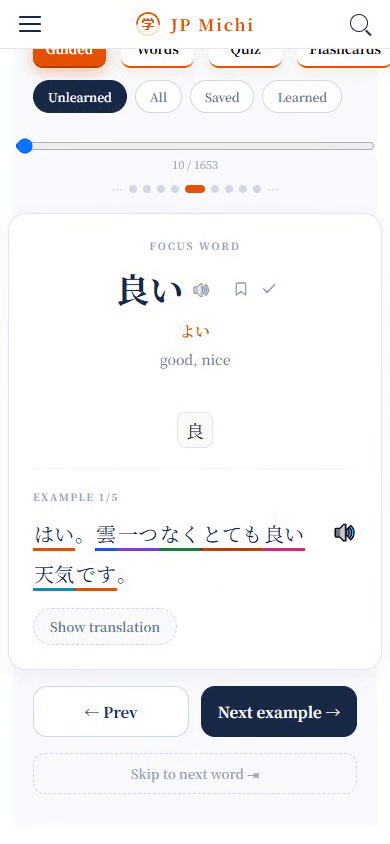
Read 良い before you reveal its meaning
Take 良い, one of the words in the walkthrough. Try saying it aloud, then read its example sentence. Can you tell what the speaker is describing as good? In Words, Guided Study lets you check the reading, hear the example and try another sentence with the same word when one is available.
Choose the mode that answers your immediate question. If you want to understand a new word, start with its explanation and example. If you want to check whether you remember it, try a card or quiz after studying it. JP Michi covers Basic and JLPT levels N5 through N1, so you can choose examples that fit your reading ability.
What does the word mean in this sentence?
The guided-word video uses 四 and 良い. The screen shows the focused word, its reading and meaning, and an example sentence. This lets you connect the dictionary entry with a sentence you can examine.
Tap the word or the sentence audio control to listen inside the app. Use Show translation when you are ready to check the sentence meaning. Next example stays with the current word when more examples are available; Next word moves your study forward.
- Read the focused word and its reading.
- Try the example sentence before revealing its translation.
- Tap the audio control and repeat a short part.
- Reveal the translation, then continue to another example or word.
When a kanji looks familiar but you forget the reading
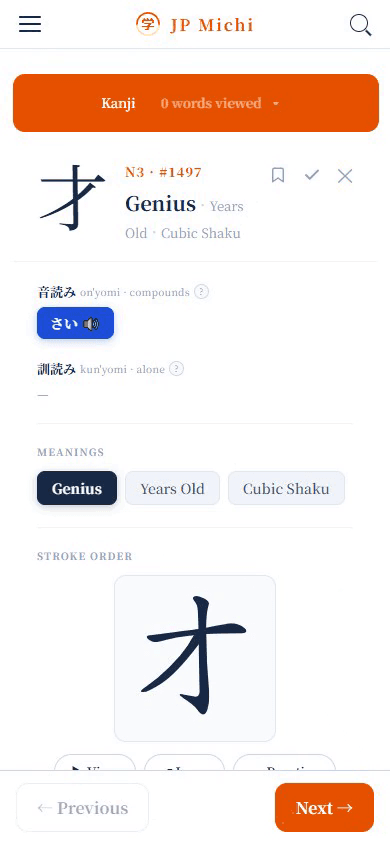
If a character keeps interrupting your reading, open Kanji from Study by Topic. A kanji card brings together meanings, readings, and stroke-order controls. The Discover recording also shows these controls on 才 and 王.
Tap a reading to hear it. Use the writing controls to watch the strokes, and open the vocabulary display to inspect words containing the character. Learn a useful word with its reading rather than expecting one pronunciation to work everywhere the kanji appears.
- Open a kanji card.
- Read its meanings and listen to a reading.
- Watch the stroke animation.
- Open the vocabulary display, then close it to return to the card.
Use flashcards and saved items for another pass
Words and Kanji both offer flashcard modes. Use them when you want another pass through material you have already encountered. You can also bookmark entries you want to revisit and use the saved or learned filters where the selected activity provides them.
Keep learning and checking separate in your own routine: first read an explanation, then return later and see what you can recognize. You do not need to mark a word learned just because you answered it once.
Answer four word-quiz questions
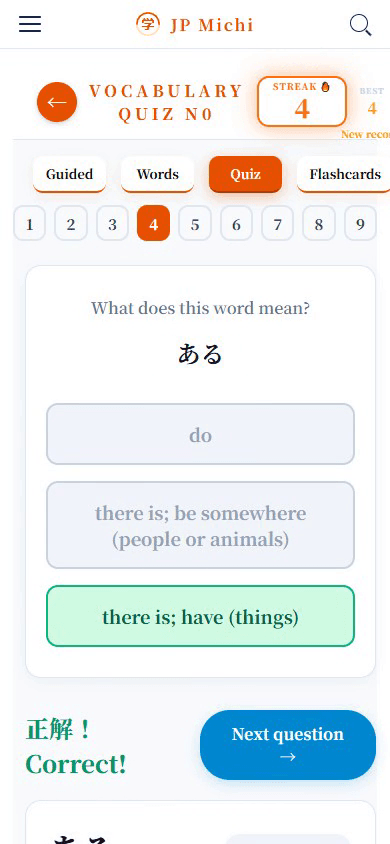
The quiz video shows four meaning questions answered correctly. Each question displays a Japanese word and a set of choices. Select the meaning you think fits, then read the feedback before moving on.
Try the four words in the clip yourself: はい, すみません, あなた and ある. Pause on each question and choose your answer before the recording shows it.
- Open Words → Quiz and choose an available level.
- Read the prompt and choose an answer.
- Check the highlighted answer and feedback.
- Use Next question to continue, or choose another numbered set.
Which words do you still remember tomorrow?
Try studying two words with examples, inspecting one unfamiliar kanji, and answering a few quiz questions. If you hesitate, return to the explanation or example instead of guessing repeatedly.
Tomorrow, open one of those words again. Say it aloud and see if you can remember the sentence where you first saw it. Then read another example. What helped you recognize the word this time?